🧨 The U.S. Just Kidnapped Venezuela’s President and First Lady — This Is Colonialism, Not “Justice.”
The U.S. bombed Caracas, seized a sitting president, and called it “law enforcement.” International law is being buried in real time
A sitting head of state was captured in his own country by the United States and flown out after a night of explosions and airstrikes in the capital. If you told people this would happen in 2026, most would’ve laughed. But it happened.
And it should terrify everyone who still believes international law means something.
Before I go further, I want to ask you from the heart to become a member today. I keep this work free for the world—for readers in Gaza, for students in public schools, for families living in deep poverty, for elders on fixed incomes—because a smaller circle of people who can afford it chooses to carry the cost. Please click here to become a memberand please click here to join as a monthly, annual, or founding member. Your support keeps this work free for them, and even for you when you can’t afford to pay.
Now let’s name what just happened, what it means, and why cheering crowds don’t make it legal.
What the Associated Press says happened
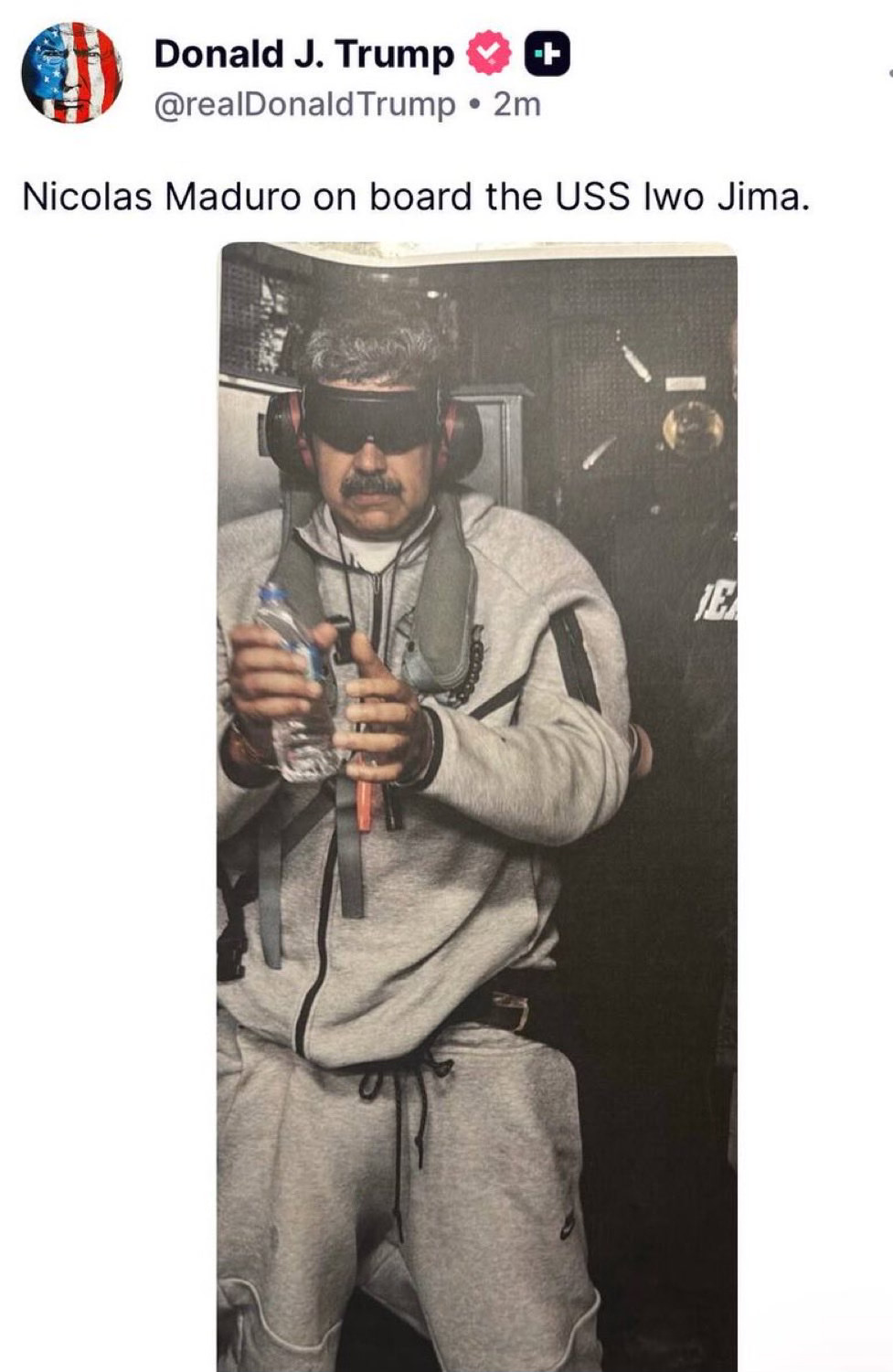
According to the Associated Press, early this morning, the United States carried out a stunning military operation inside Venezuela that ended with the capture of President Nicolás Maduro and his wife Cilia Flores. The AP reports that multiple explosions and low-flying aircraft were heard around 2 a.m. in Caracas, and that Maduro and Flores were taken from their home on a military base and flown out of the country. The AP reports Trump said they were aboard the U.S. warship Iwo Jima headed to New York, where the administration plans to prosecute them. The AP also notes that the legal authority for this operation was not immediately clear, and explicitly compares it to the 1990 U.S. invasion of Panama and seizure of Manuel Noriega.
Let’s pause there. Because whether you hate Maduro, love him, or have never thought about Venezuela once in your life, this is the point: the United States just executed a military seizure of a sitting leader from inside his own country and is hauling him to American courts.
That is not normal.
That is not “a bold arrest.”
That is regime-change warfare dressed up as law enforcement.
The AP also reports that Venezuelan officials said civilians and members of the military were killed, without giving a number, and that Trump said some U.S. forces were injured. Venezuela called it an “imperialist attack” and urged people into the streets.
Then you look around and you see videos: smoke rising, panicked streets, security forces mobilized, people celebrating, people crying.
And that’s where the propaganda will start to settle: “Look, some Venezuelans are cheering.”
Yes. Some people are cheering.
And it doesn’t matter.
Cheering crowds don’t legalize kidnapping a president
Conservatives and war hawks are going to say, “Well, people are celebrating.” But that is not how legality works. That is not how sovereignty works. That is not how international order works—at least, not on paper.
Here’s the simplest way to say it:
If somebody came into the United States, bombed parts of Washington, D.C., and kidnapped Donald Trump to “stand trial” overseas, millions of Americans would cheer. They would throw parties. They would do backflips. They would call it liberation. They would say it’s justice.
Would that make it legal?
Of course not.
In almost any country on earth, if the president was seized, you would find some group of people who approved. That’s true everywhere. That’s not the moral test. That’s not the legal test. That’s not the standard.
The standard is: Do you have the lawful authority to invade another sovereign state and remove its leader by force?
And the answer under international law is almost always: no.
International law, in plain English
The UN Charter is not a suggestion. It is the closest thing the world has to a rulebook for how states are supposed to behave. But international law is only as effective as it is enforced.
The core rule is simple: states are prohibited from using force against the territorial integrity or political independence of another state, except in very narrow circumstances like self-defense against an actual armed attack, or with authorization from the UN Security Council.
What happened in Venezuela is not being presented as a UN-authorized action. It is not being presented as a collective security action. It is being presented as an American decision.
The AP itself notes the legal authority was not immediately clear.
AFP reports Venezuela’s defense minister accused the U.S. of striking residential areas and called it a “flagrant violation of the United Nations Charter and international law,” while announcing a “massive deployment” of capabilities. Bloomberg reports China called the U.S. action a “blatant use of force against a sovereign state,” saying it violates international law and threatens regional peace.
So the global reaction from serious states is already framing this as illegal.
And this is where we have to be honest with ourselves: international law means next to nothing when the United States decides it doesn’t apply.
That’s not a cynical hot take. That’s the lived reality of the last two-plus years.
Gaza taught the world that rules don’t restrain power
I don’t say this lightly: the genocide in Gaza has done something catastrophic to the global order.
For over two years, the world has watched mass slaughter, starvation, siege, displacement, destruction of hospitals, killing of journalists and aid workers—and we’ve watched the most powerful governments on earth enable it with weapons and vetoes.
We’ve watched the UN issue statements and hold meetings while children die.
We’ve watched courts be pressured, attacked, undermined, dismissed.
We’ve watched “rules-based order” become a slogan used only against enemies, never against allies.
So when the United States bombs Caracas and kidnaps a head of state and says it will prosecute him in New York, the message is not “justice.”
The message is: the UN is ornamental. International law is optional. Power decides what is real.
We are living in an age of unchecked power.
And the most dangerous thing about unchecked power is that it doesn’t stop with one target.
Congress wasn’t asked — because they know Americans don’t want this
The New York Times reported that Trump did not seek congressional authorization to capture Maduro and that Democrats raised constitutional concerns. Senator Andy Kim accused Marco Rubio and Pete Hegseth of “blatantly” lying to Congress about not seeking regime change. The Times reports that some Republicans cheered and later rationalized it as an “arrest,” and that Mike Lee said Rubio told him Maduro was arrested to stand trial and that Rubio “anticipates no further action.”
Here’s the problem with that framing.
You cannot bomb your way into another country, seize its leader in a military operation, and call it “an arrest” as if it happened on a street corner in Brooklyn.
That’s not what an arrest is. That’s what an invasion looks like.
And even on the domestic law side, the U.S. Constitution gives Congress the power to declare war. Presidents have spent decades stretching and abusing war powers, but this is a new level of open contempt: a strike, a seizure, and a plan to shape Venezuela’s future, all without transparent authorization.
The AP also notes the Armed Services committees were not notified, according to a person familiar with the matter. That’s the administration treating Congress the way empires treat legislatures: as an inconvenience.
Why would they bypass Congress?
Because they know Americans are exhausted. They know Americans are not clamoring for another overseas conflict. They know the minute Congress has to vote, the truth becomes harder to hide.
So they do it first, and then dare the country to accept it.
The “drug war” script is the oldest cover story in the book
Trump is selling this under “narco-terrorism” and cartel language. The AP reports a new indictment and that officials are invoking “narco-terrorism conspiracy.” The administration has spent months bombing boats and claiming drug smuggling, while critics have said the evidence has not been publicly provided.
Then, as if to show this isn’t about Venezuela alone, Trump goes on Fox & Friends (as reported by Mediaite) and starts floating that “something’s gonna have to be done with Mexico,” describing cartels as running the country and claiming he has repeatedly offered to “take out the cartels.”
That is the roadmap.
Step one: label a country’s problem as a threat to Americans.
Step two: declare the country “out of control.”
Step three: present U.S. force as the only solution.
Step four: normalize intervention as a moral duty.
This script has been used for decades. It’s been used in Latin America, in the Middle East, across the globe.
And it always leaves behind devastation, instability, and a trail of “whoops” explanations once the bodies pile up.
“We’ll be involved very much”: the colonial confession
Trump told Fox News, according to the AP, “We’ll be involved in it very much,” and, “We can’t take a chance in letting somebody else run and just take over what he left.”
Read that carefully.
That is not the language of a limited operation. That is the language of control. That is the language of someone who believes Venezuela is not sovereign.
It is colonial language.
It echoes a long history of American interventions in Latin America: Chile, Guatemala, Nicaragua, Panama, and more. It echoes a worldview where the U.S. decides who gets to govern, who is legitimate, and who gets removed.
And because the U.S. can do it, the U.S. expects the world to accept it.
This is why China’s condemnation matters. Not because China is morally perfect—no state is. But because it reveals what’s happening geopolitically: major powers are now openly describing U.S. actions as hegemonic and illegal, and the region is being pulled into a broader confrontation between U.S. imperial posture and rival power blocks.
Venezuela is oil-rich, strategically positioned, and economically entangled with countries like China. You cannot rip its head of state out of the country without creating ripples.
This isn’t “law enforcement.” This is global destabilization.
The moral point Americans can’t avoid
Americans have been taught to treat our military as a force for good. We’ve been taught to believe our interventions are fundamentally different than everybody else’s.
But if another country did this—if Russia did this to Ukraine, if China did this to Taiwan’s leadership, if Iran did this to an ally—we would call it exactly what it is:
a kidnapping.
an invasion.
an act of war.
a violation of sovereignty.
We wouldn’t accept “but they’re indicted.”
We wouldn’t accept “but their president is a tyrant.”
We wouldn’t accept “but some people are cheering.”
We’d say: international order has been shattered.
And that’s the truth today.
Now, I’m not here to defend Maduro’s record. Venezuela’s leadership has faced serious allegations for years, and many Venezuelans have suffered under political repression and economic collapse. None of that grants the United States the right to bomb a capital and seize a president.
Because if we accept that standard, we’ve accepted the end of law.
We’ve accepted the principle that the strongest nation can decide who lives, who governs, and who gets dragged into court.
That’s empire. That’s not justice.
What happens next is the part that keeps me up
The AP reports Venezuela’s vice president said she wanted proof of life, and that under Venezuelan law she would take over, though there was no confirmation. AFP reports a massive deployment. Bloomberg reports global condemnations.
This is how civil conflict grows. This is how power vacuums open. This is how proxy fights begin.
And even if some Venezuelans celebrate, the destabilization affects everyone: hospitals, food, currency, safety, migration flows, regional diplomacy.
This is what “stunning operations” do: they explode a country’s internal equilibrium and then leave ordinary people to manage the chaos.
And that is exactly why international law exists: to prevent powerful states from lighting fires and calling it morality.
But we are now watching the rules erode in real time.
The age of unchecked power is here — and Gaza proved it
If you want the through line, it’s this: Gaza proved to the world that power can commit atrocities openly and face minimal consequences when protected by the United States.
Now Venezuela is being taught the same lesson from the other end: if the U.S. decides you are a problem, it can bomb your capital and take your leader.
The UN can convene meetings. Courts can issue statements. Allies can condemn. And the U.S. can shrug.
That is the age we’re in.
And it’s why we have to keep building independent media that refuses to be hypnotized by cheering crowds and patriotic scripts.
If you want me to keep doing this work—fast, clear, morally honest, grounded in receipts—please stand with me now. Please click here to become a member and please click here to join as a monthly, annual, or founding member. I keep this work free for the world, but it only survives if some of you decide to carry it.
Love and appreciate each of you.
Your friend and brother,
Shaun
Don’t Stop Here. Here are 3 FREE articles for you…
🧨 The Epstein Pedophile Pipeline Ran Through Trump's Mar-a-Lago Spa — And the Receipts Are Ugly. And Undeniable.
In the middle of all the noise around Epstein, one detail should stop every American in their tracks: Mar-a-Lago’s spa was sending young women to Jeffrey Epstein’s house for “services” for years. Not rumor. Not a conspiracy thread. A system. And according
🗽✨ Let Me Tell You About the Qurans Used for the Swearing in of New York City Mayor Zohran Mamdani
Less than a year ago, I watched Zohran Mamdani speak to a room that barely noticed him. Now he’s the Mayor of New York City — and the way he took the oath last night was a message to the whole world about who belongs in this city.


I am so disgusted.
I really would like to see how all of you think and feel about this. The world is now fully lawless.