

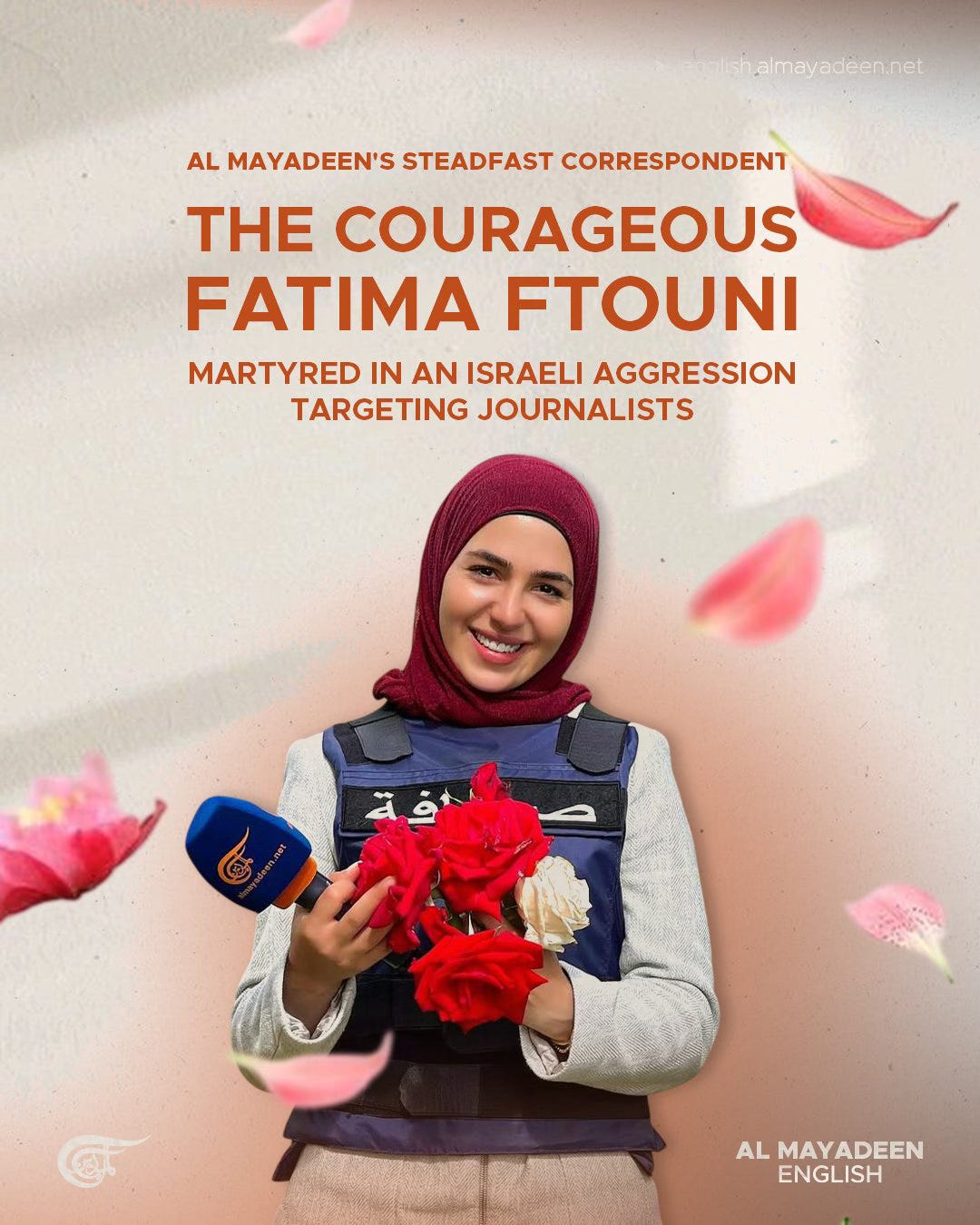
Fatima Ftouni and Ali Shoeib were not just random names in a breaking-news ticker. They were two of the most respected journalists in Lebanon, two people whose work mattered because they insisted on standing where danger was greatest and truth was hardest to deny. And now they are dead after multiple Israeli strikes on a clearly marked press vehicle in southern Lebanon.
This work stays free for the world because readers who can afford to support it choose to carry readers in Gaza, readers in Sudan, readers living in deep poverty, and even readers here at home who cannot always afford a paywall. Please click here to join as a monthly, annual, or founding member and help us keep publishing receipts, documents, and moral clarity when others go quiet.
What makes this story so sickening is not only the grief. It is the clarity of it. The people killed were not hidden. They were not anonymous figures moving in secret through the dark. They were journalists. They were visible. They were wearing press gear. The vehicle was marked. The word PRESS was not subtle. It was not coded. It was not ambiguous.
And Israel is not denying any of this. Their government literally posted the video for the whole world to see.
They were there to bear witness
One of the things I hate most about how these stories get told is the way beloved human beings are flattened into sterile nouns. “Media workers.” “Casualties.” “Two killed.” As if language itself has been trained to help us look away. But the people mourning Fatima Ftouni and Ali Shoeib are not speaking in that cold, dead language. They are speaking like people who knew them, loved them, respected them, and understood what they meant to Lebanon.
Fatima was described by her colleagues as brave, steadfast, warm, and deeply committed to her profession. One grieving journalist wrote that he watched her grow over the years into one of Lebanon’s most fearless journalists. Another post described her dream of a free Palestine. A colleague reportedly pulled a Palestinian kuffiya from her car after the strike and said she kept it there because she loved Palestine and dreamed of its freedom. That detail is almost too painful to hold. A young journalist with a kuffiya in her car, with dreams larger than herself, murdered while doing the work of telling the truth.
Ali Shoeib was not some obscure figure either. He was widely described as a top frontline reporter, one of the men people had been relying on for updates as Israel’s assault on Lebanon intensified. In other words, this was not just an attack that took lives. It took voices the public had come to trust in the middle of catastrophe.
And then there is Mohammad Ftouni, Fatima’s brother, also killed. Even that fact feels like a whole second tragedy inside the first one. This story is not just about a battlefield. It is about a family shattered and colleagues left trying to make sense of the unspeakable.
They were marked as press
This is the center of the whole moral argument, and nobody should let it be blurred.
We can see the vests. We can see the markings. We can see the kind of visibility that is supposed to protect reporters under the basic norms of human decency and international law. A journalist in a press vest is not supposed to be turned into a target. A marked press vehicle is not supposed to become a death trap.
That is why euphemism here is not just cowardly. It is obscene.
This was not “crossfire.” It was not random misfortune falling from the sky. It was the reported targeting of journalists who were clearly identified as journalists. And once you see it that way, the entire moral burden of the story changes. You can no longer hide behind passive grammar. You can no longer say they “died” as if death just arrived on its own and chose them.
They were targeted. Israel openly admits as much.
That is what the outrage is about. That is what the world keeps trying not to say.
The horror did not end with the first strike
After the initial strike on the journalists, a medical crew showed up to help, when Israel bombed them again. We call this a double-tap strike.
Because then this is not only an attack on journalists. It is an alleged attack on the human instinct to rescue.
Think about what that means. The first blast tears through the scene. People run toward the dead and wounded because that is what decent human beings do. They run to help. They run to lift bodies. They run to stop bleeding. They run because mercy has not yet been beaten out of them. And if the area was then struck again, what is being targeted is not only a car, not only reporters, but compassion itself.
There is a special kind of evil in teaching people that even the act of rescue may get them killed.
This is not an isolated story
We have now surpassed 300 journalists that Israel has killed in the Middle East over the past 3 years. That’s more journalists killed by a government than all previous modern wars combined.
Al Mayadeen, the news organization that these two martyred journalists worked for, also stated this is not even the first time its journalists have been targeted and killed by Israel. It names earlier killings of its correspondents and cameramen in November 2023 and October 2024.
For more than two years now, the current phase of the genocide in Gaza has also been a war on witness. Not just a war on homes, hospitals, schools, refugee camps, universities, mosques, churches, and aid workers. A war on the people documenting the destruction. A war on the people whose cameras, notebooks, flak jackets, and live hits make it harder for the killers to lie.
And once the world let that become normal in Gaza, once the killing of Arab journalists was absorbed into the daily weather of the news cycle, the boundary moved. That is how impunity works. It expands. It learns from silence. It becomes bolder.
First Gaza. Then Lebanon.
At every stage, the world is asked the same question: how many dead Arab journalists will it take before you stop pretending not to understand what is happening?
What the law is supposed to mean
Let me say this as plainly as I can. Journalists are civilians. And under the laws of war, civilians are not supposed to be intentionally targeted. A war crime is not just a horrible act committed during war. It is a grave violation of the rules that are supposed to protect human beings even in war. Reporters in clearly marked press gear are supposed to be among those protected, not hunted.
That is why these details matter so much. The vest matters. The markings matter. The vehicle matters. The witness accounts matter. If the evidence supports what so many of these posts are alleging, then this is not just another ugly headline from another ugly day in the region. It is a profound legal and moral crime.
And yet look at how often the global conversation still bends over backward to soften these realities when the victims are Arabs or Muslims.
The hierarchy of whose life counts
This is where I need to say something that should already be obvious, but apparently still is not.
If two famous American, British, or French correspondents were killed in a vehicle marked PRESS, every major newsroom in the United States and Europe would know exactly how to respond. There would be no confusion about tone. There would be no immediate retreat into sterile phrases about “competing claims.” Their colleagues would be on air in tears. Editorial boards would thunder. Press freedom groups would dominate the conversation. The names and faces of the dead would lead the news cycle for days.
And they should.
But that same instinct, that same solidarity, that same fierce defense of journalism somehow keeps failing when the journalists are Lebanese, Palestinian, or otherwise Arab or Muslim. Then suddenly we are told to wait. Suddenly we are asked to be nuanced about whether a person in a press vest, in a marked press vehicle, may have somehow wandered into their own killing. Suddenly the world’s greatest defenders of free expression start sounding like public relations interns for empire.
It is despicable.
And it is not neutral.
Every time a major institution cannot bring itself to condemn the killing of Arab journalists with the same moral force it would summon for Western ones, it sends a message. The message is that some witnesses matter more. Some dead reporters are more grievable. Some press vests carry more value than others.
That hierarchy is rotten. It is racist. And it is helping kill people.
Fatima should not be swallowed by passive verbs
I keep coming back to Fatima Ftouni because this is how resistance to dehumanization has to work. You keep saying the name. You keep telling the truth about the life. You keep refusing the machinery that turns a beloved woman into a statistic.
A young journalist. A respected correspondent. A woman her colleagues described with affection and admiration. A woman who had already lived through unimaginable pain. A woman who dreamed of a free Palestine. A woman who got dressed for work, put on gear that marked her as press, and never came home.
That should haunt the conscience of the world.
And Ali Shoeib should haunt it too. So should Mohammad Ftouni. So should every reporter, photographer, videographer, fixer, and editor who has been killed while trying to document what powerful men would rather hide.
The point of murdering journalists is not only to kill a person. It is to kill the public’s access to reality. It is to intimidate everyone still alive. It is to say: if you show the world what we are doing, this can happen to you too.
That is why the killing of journalists is always bigger than the individual crime. It is an attack on memory. On truth. On history. On the record itself.
The world is being tested again
Right now, the world is being asked, once again, whether it will look at dead Arab journalists and say less than the truth.
Whether it will hide behind phrases like “amid rising tensions.” Whether it will launder accusation into atmosphere. Whether it will wait for the killers to explain themselves before defending the dead. Whether it will continue treating journalists from one part of the world as if they are somehow less fully press, less fully human, less fully worth outrage.
It should refuse.
This work remains free for the world because people who can help choose to help, and that keeps it free for readers who cannot afford to pay, here and around the globe. That support is what allows us to keep naming what others sanitize, and keep telling the truth when powerful institutions would prefer silence.
Love and appreciate each of you.
Your friend and brother,
Shaun

Do Not Stop Here! Below are FREE articles for you…
🚨 Benjamin Netanyahu Literally Slept in Jared Kushner’s Childhood Bed. Kushner is Fully Compromised. The Sooner We Admit This the Better.

When I first heard this detail, I felt my stomach drop.
🦞🥩 In just ONE MONTH, Pete Hegeth Spent $22 million of taxpayer money on ribeyes and lobster tails. Yes, I'm dead serious.

The Trump administration keeps telling us there’s “no money.”
Let's Be Honest. American Soldiers Aren't Dying for America. They Are Dying for Israel and Israel Alone. And We All Know It.

The North Star with Shaun King is a reader-supported publication. To receive new posts and support my work, consider becoming a free or paid subscriber.
I hope you all never stop caring. I hope that you NEVER get used to this.
There is nothing more foul than people who boast about their murders.